
/ All articles
.jpg)
---
Over the past few years, the way companies develop software has undergone significant changes. Low‑code adoption has skyrocketed more than 65 % of new applications by the end of 2024 were built with low‑code or no‑code tools, compared with only 25 % in 2020. Analysts expect that more than half of medium and large companies will consider low‑code platforms a strategic necessity by 2027. This surge reflects the need to innovate quickly amid the pressures of digital transformation and a persistent shortage of skilled developers.
Yet traditional development, where engineers write code line by line remains indispensable. Custom code provides unmatched control over architecture, security, and performance, which is crucial for complex or regulated systems. As a result, organizations must understand both methods to choose wisely or blend them effectively.
Traditional software development involves designing and coding applications from scratch using languages like Python, Java, C#, PHP, JavaScript, C++, Ruby, Go, Swift and other modern languages. Projects follow a structured life cycle of planning, design, coding, testing and deployment. Because every layer of the system must be handcrafted, the process requires experienced developers and tends to be labor‑intensive.
This approach excels when full customization is needed. Developers can tailor the architecture and logic to specific requirements, optimize performance, enforce bespoke security controls, and avoid vendor lock‑in. However, these benefits come at a cost. Projects can take weeks or months to complete, demanding larger teams and budgets. Maintenance, updates, and enhancements also rely on ongoing developer support, making it difficult for non‑technical staff to contribute. Despite these challenges, traditional coding remains the gold standard for high‑performance systems and highly regulated industries.
Low-code development offers a different approach: building software visually. Platforms such as Microsoft Power Platform, OutSystems, Salesforce Lightning, and Bubble provide drag‑and‑drop tools, pre‑built components, and automation features so that teams can assemble applications without writing extensive code. This approach democratizes development: business analysts and project managers can quickly turn ideas into working prototypes, while professional developers utilize the same platform for more sophisticated features.
The advantages are significant. Low‑code accelerates time‑to‑market applications that once took weeks can be built in days. Reducing the need for specialized developers lowers costs and empowers non‑technical stakeholders. Platforms often include built‑in encryption, role‑based access controls, and compliance frameworks, reducing the complexity of securing data. Ready‑made connectors to APIs and databases simplify integration with existing systems. On the downside, pre‑defined components may limit customization, some platforms require ongoing subscription fees, and vendor lock‑in can be a concern. Nonetheless, for many use cases, low‑code dramatically lowers the barrier to innovation.
“Low‑code platforms deliver unmatched speed and cost‑efficiency, letting organizations prototype and launch applications in days instead of weeks while fostering collaboration between business and IT teams.”
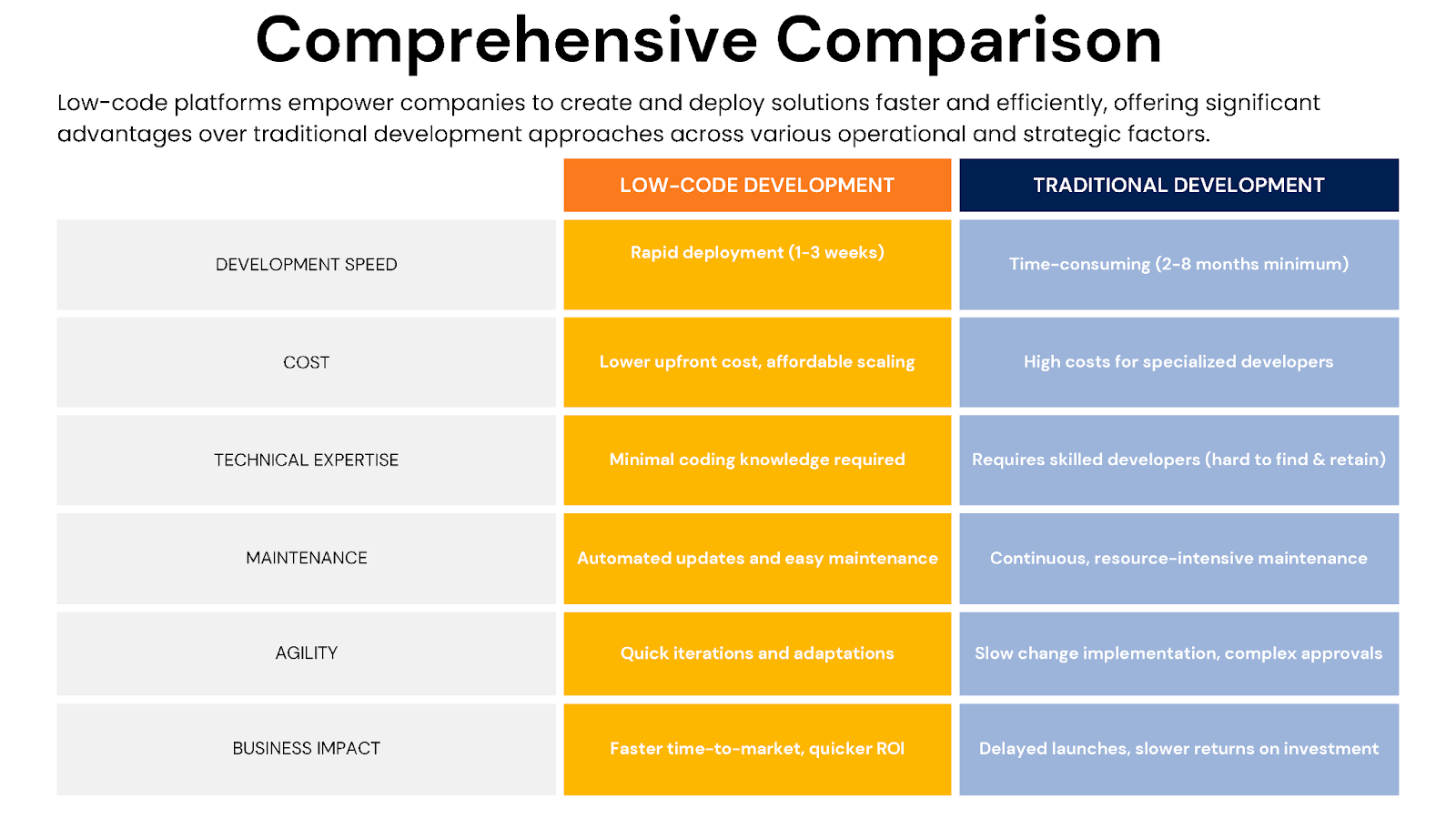
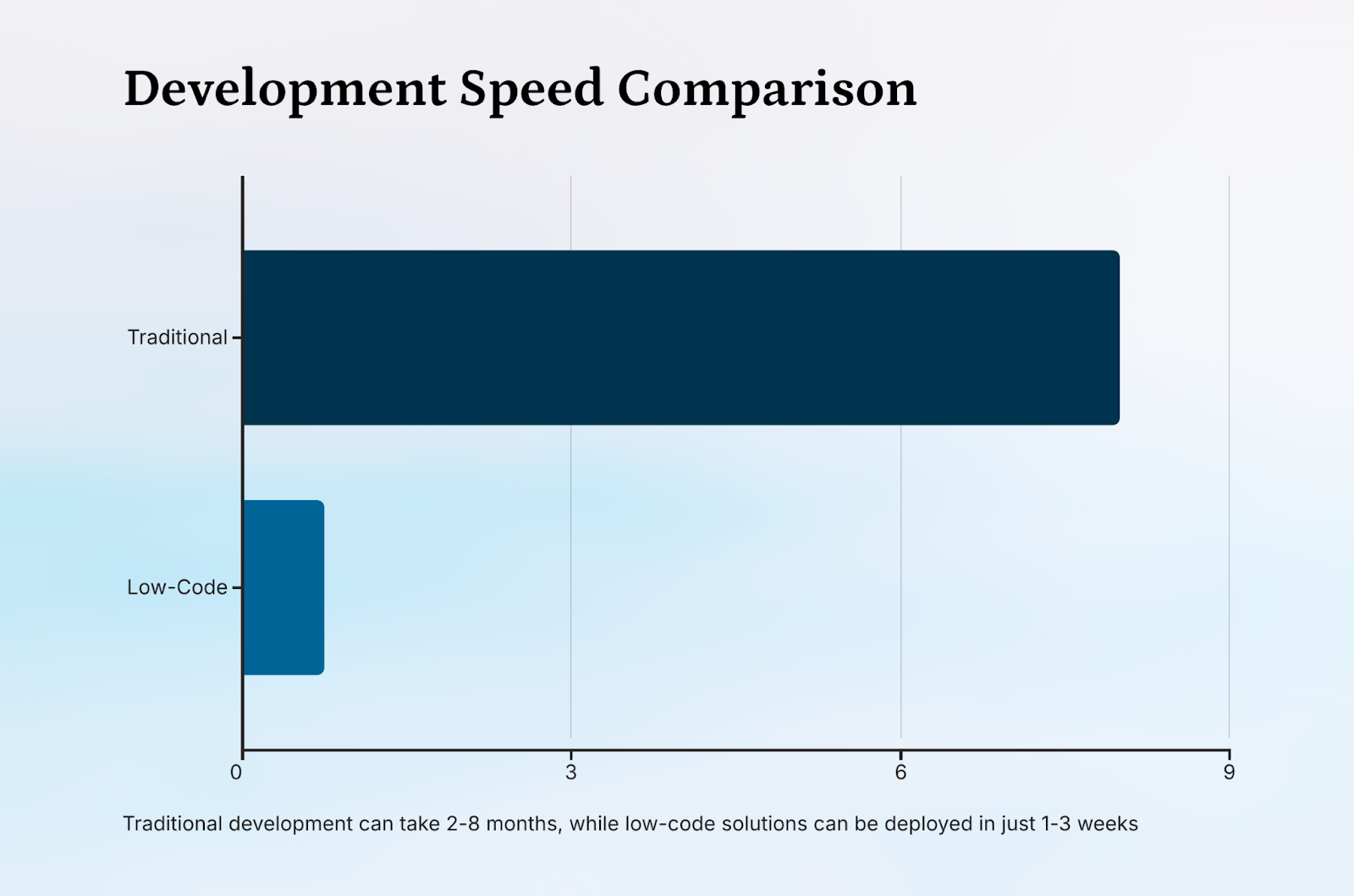
Low‑code’s biggest selling point is speed. Visual tools and reusable components let teams build and iterate much faster than hand-coding. This agility allows organizations to respond quickly to market feedback or internal needs, launching prototypes or internal tools in days rather than weeks. Traditional development, by contrast, requires detailed planning and manual coding; even with agile methods, the process takes longer.
The two approaches also differ in who can participate. Low‑code democratizes development by allowing business users to contribute directly. This collaboration bridges the gap between IT and the business and eases the strain on scarce developer resources. Traditional coding, however, demands specialized skills, limiting participation and creating knowledge silos.
From a cost perspective, low‑code projects often require fewer developers and shorter timelines, reducing labour and infrastructure expenses. Built‑in testing, hosting, and updates further contain costs. Licensing fees must be considered, but they’re often offset by faster ROI. Traditional projects have higher up‑front costs because they need larger teams and longer development cycles. Over the long term, however, owning the codebase can provide strategic flexibility and avoid ongoing platform fees.
Low-code platforms excel in scenarios where speed and simplicity are crucial. They’re ideal for rapid prototyping or building minimum viable products: teams can test new ideas and gather user feedback in a fraction of the time it would take with hand coding. Internal tools such as employee onboarding apps, leave management systems, expense trackers, and asset management dashboards are perfect low‑code candidates because they rely on forms, workflows, and approvals that pre‑built components handle well.
The same applies to customer‑facing applications that need responsive interfaces, such as service booking portals, support ticket systems, and feedback forms. Low‑code simplifies integration with CRM or ERP systems, enabling teams to build complete solutions with minimal code. For business process automation, low‑code tools can automate sales lead management, inventory tracking, or project management workflows, providing real‑time visibility and reducing manual effort. Finally, organizations with limited developer resources benefit from low‑code because it empowers citizen developers and reduces bottlenecks.
Despite the excitement around low‑code, traditional development remains essential for certain scenarios. Complex, performance‑critical systems like high‑frequency trading platforms or large‑scale e‑commerce sites often require fine‑tuned optimization and deep customization beyond what low‑code can support. Applications that demand unique user experiences or advanced graphics may exceed the capabilities of pre‑built components.
Compliance requirements can also dictate the need for custom code. Industries such as healthcare and finance need bespoke security implementations and audit trails that may not be fully supported by off‑the‑shelf platforms. Organizations that prioritize full ownership of their codebase, or that wish to avoid vendor lock‑in, may choose traditional development to maintain long‑term control. In these cases, the additional time and cost are justified by the level of customization and assurance provided.
Many businesses rely on older systems that are deeply embedded in their operations. Integrating these legacy systems with new applications is challenging and expensive when done solely through custom coding. Low‑code platforms mitigate this by offering connectors and API integration capabilities that allow teams to extend existing functionality without rewriting core systems. These features enable gradual modernization while preserving critical business processes. In contrast, traditional integration requires custom code and a deep understanding of the legacy architecture, resulting in long-term maintenance burdens and a dependency on specific developers.
At SDC LEKA, we don’t view low‑code and traditional development as competitors; we see them as complementary tools. Our process begins with a strategic assessment to understand each client’s goals, constraints, and technical landscape. We identify where low‑code can deliver rapid value and where custom coding is necessary for differentiation or compliance. During collaborative design, we bring business stakeholders and developers together to ensure that the solution meets real user needs and aligns with business objectives.
We then apply rapid development using platforms like Bubble, Xano, FlutterFlow, and Webflow to produce prototypes and full applications quickly. Each project undergoes rigorous testing for performance, security, and user experience, and we add custom code where needed to overcome platform limitations. Once live, SDC LEKA provides ongoing support to adapt to evolving requirements. This holistic approach ensures that clients benefit from the speed of low‑code without sacrificing quality or control.
“The choice between traditional and low‑code development isn’t about selecting one over the other, it’s about finding the right approach for each specific need and challenge.”
The most successful software strategies in 2025 will likely adopt a hybrid model. By combining low‑code with traditional coding, organizations can accelerate time‑to‑market while maintaining flexibility and quality. Low‑code handles routine tasks and accelerates prototyping, enabling quick feedback loops and rapid iteration. Traditional coding supplements these platforms when bespoke features, deep integrations, or performance optimizations are required. This synergy optimizes resource allocation, allowing business users to handle simple workflows while freeing developers to focus on complex, high-value tasks. The result is adaptable, high‑quality applications that deliver long‑term value and scale with business needs.
Low‑code platforms are transforming software development by democratizing access and enabling unprecedented speed. Traditional coding, however, remains critical for custom, high‑performance, or highly regulated solutions. By understanding the strengths and limitations of each method, organizations can choose the right approach or combine both to achieve their goals.
SDC LEKA helps businesses navigate this landscape by tailoring a strategy that blends low‑code agility with traditional rigor. Whether you’re automating internal processes, modernizing legacy systems, or building a customer‑facing app, we can guide you to the right mix of technologies.
Contact SDC LEKA for a consultation, and stay tuned to our blog for more insights on low‑code, no‑code, custom software development, and more technology business insights.

Dolores Crazover is a transformational Software & AI Engineer and the founder of SDC LEKA, a competitive IT services company driven by the power of Innovation.
SDC LEKA helps businesses grow smarter and strengthen operations through AI, automation, human-centered design, and access to elite tech experts revolutionizing how organizations operate and how people experience technology.
With a background in science and engineering and a career built at the intersection of technology, strategy, and impact, Dolores has led global initiatives across health & beauty, luxury, consulting, fintech, and digital innovation. She has co-founded several ventures, including an AI- and VR-driven wellness platform that delivered intelligent B2B experiences for global beauty and health brands.
As a tech founder at heart, she has co-built international AI communities spanning 30 chapters (including Miami), connecting founders, developers, investors, and partners to collaborate and shape the next wave of intelligent innovation.
Passionate about bridging technology and entrepreneurship, she guides innovation leaders and cross-functional teams, from emerging ventures to global organizations to scale with purpose, turning bold ideas into meaningful impact. Beyond business and technology, Dolores finds inspiration in nature, music, and the quiet beauty that fuels creativity and wonder.

.jpeg)
.png)
.svg)
